Constitutional Authorization Infrastructure
Securing Sovereign Transaction Control.
Every transaction within a sovereign jurisdiction passes through an authorization layer — the cryptographic confirmation that a verified individual is permitted to execute a specific transaction. Today, this layer is operated by a small number of foreign-domiciled entities. KeyIdentity returns this constitutional function to sovereign authority through federated infrastructure that operates under national governance, without centralized biometric databases, and without dependence on foreign authorization rails.
Token TTL
120 Seconds
Federation
Sovereign Mesh
Biometrics
Non-Persistent
Federated Authorization for Regulated Environments
KeyIdentity builds the cryptographic trust layer between identity verification and transaction authorization. The KeyIdentity Federation Protocol (KIFP) enables compliant participants to issue, verify, and revoke identity-bound authorization tokens without sharing biometric data, without persisting credentials beyond a single transaction, and without requiring bilateral trust agreements between every pair of participants.
KIFP is a formal protocol specification — not a proprietary system. Sovereign participants operate their own national infrastructure under their own authority. The protocol is the standard. The infrastructure is sovereign.
Architectural Guarantees
Sovereign Control
National infrastructure operated under national authority. Sovereign Nodes are physically located within the jurisdiction, governed by national policy, and auditable by national regulators. No foreign entity determines which transactions are authorized within your borders.
Constitutional Separation
The protocol that governs authorization is constitutionally separated from the commercial entity that deploys infrastructure. The protocol cannot be acquired, modified by shareholders, or transferred through corporate transaction. It persists regardless of commercial ownership.
Biometric Non-Persistence
No biometric data enters the protocol. Verification occurs on certified local hardware. The biometric template exists only on the device where enrollment occurred. No central biometric database exists, has ever existed, or can be constructed from system data.
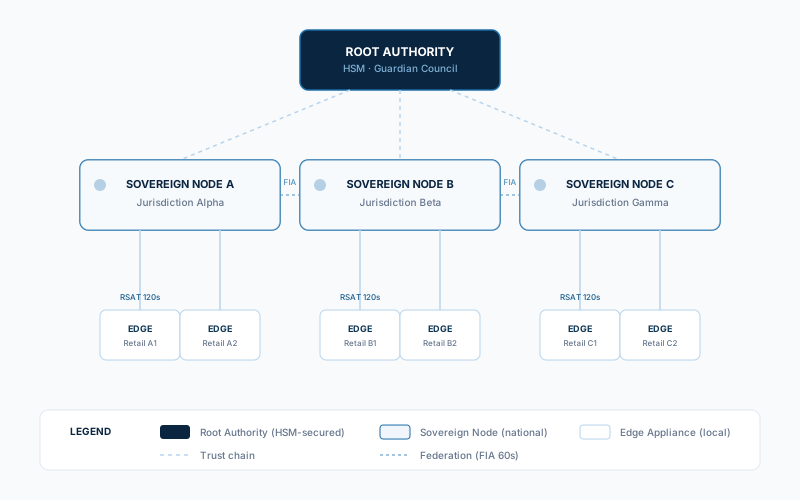
Federation Topology
Root Authority to Sovereign Nodes to Edge Appliances — a hierarchical trust chain with per-transaction ephemeral credentials.
Institutional Scope
This website serves as the institutional reference for the KeyIdentity Federation Protocol. It is intended for sovereign institutions, financial regulators, central banks, and critical infrastructure operators evaluating federated authorization infrastructure.
KeyIdentity does not offer consumer services, retail accounts, or publicly accessible software. The protocol specification, governance framework, and technical architecture are documented here for institutional review. Engagement is conducted exclusively through formal institutional channels.
Ready for Institutional Evaluation?
KeyIdentity engages with sovereign institutions, financial regulators, and critical infrastructure operators through formal institutional channels.